Jib Crane vs Davit Crane: Key Differences & How to Choose
Why Users Confuse Jib Crane and Davit Crane
Many buyers confuse two common rotary boom lifting devices due to their compact structure and flexible operation. However, their jib crane design, load capacity, structural stability and applicable scenarios differ greatly. Choosing the wrong unit leads to poor performance or unnecessary costs. This guide compares their core features to help users select reasonably according to actual job demands.
Basic Definition & Features
What Is a Jib Crane?
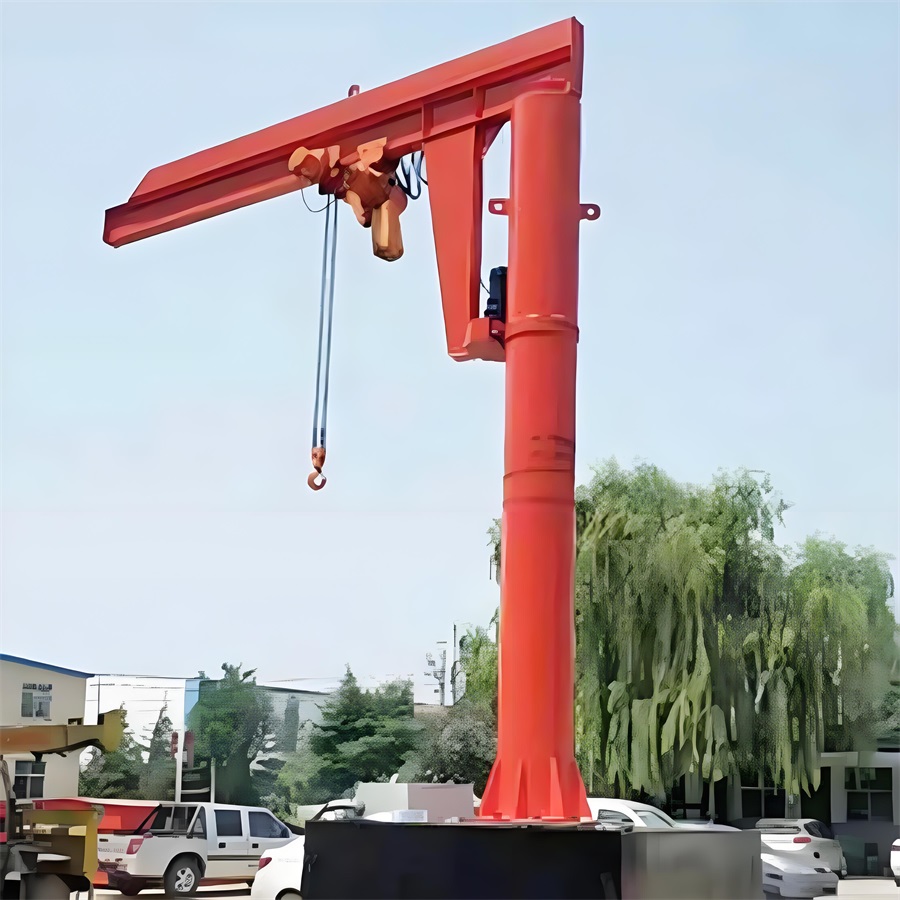
A jib crane is a rigid industrial lifting system with columns, boom beams and stable base structures. Built for medium and small tonnage handling, it supports high-frequency, long-term cyclic operation for standard industrial environments.
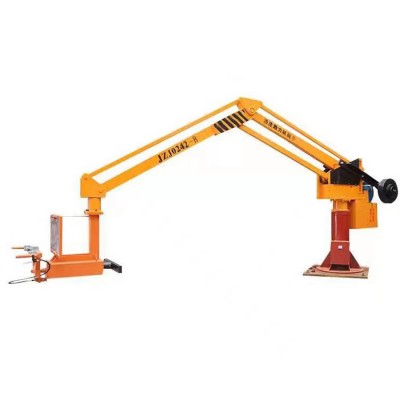
Common types of jib cranes include mobile, wall-mounted, floor cantilever crane and swing models. Custom fully electric wall running jib crane units enable automatic traveling and electric rotation to boost workshop efficiency.
What Is a Davit Crane?
A davit crane is a lightweight, mini lifting tool with a simple boom and portable base. It focuses on fast deployment rather than long-term stability, designed exclusively for low-load, temporary lifting in confined spaces.
Featuring tool-free assembly and ultra-small footprint, it is widely used for high-altitude edge lifting, wellhead hoisting and narrow-site temporary handling tasks.
Differences Between Jib Crane and Davit Crane
The two devices have essential differences in performance and application, summarized as follows:
Load Capacity: Jib cranes support medium industrial loads with sufficient safety margins for repeated production use. Davit cranes only adapt to ultra-light loads and cannot bear long-term medium-load stress.
Stability & Durability: Jib cranes adopt integrated thick steel structures for strong deformation resistance and fatigue resistance. Davit cranes prioritize portability, resulting in weaker rigidity and obvious shaking under load.
Working Range: Jib cranes offer large, customizable working radius and lifting height for wide-area operation. Davit cranes only support short-distance, fixed-point vertical lifting.
Installation & Mobility: Jib cranes require standardized jib crane installation with fixed or mobile deployment. Davit cranes need no fixed installation and support rapid disassembly and transfer.
Operation Frequency: Jib cranes fit high-frequency daily cycling work. Davit cranes are only for intermittent, low-frequency temporary lifting.
Cost & Maintenance: Jib cranes have higher investment but lower long-term failure rates. Davit cranes feature low upfront cost and almost no daily maintenance.
Pros & Cons Analysis
Jib Crane
Advantages: Reliable stability and load performance support high-intensity industrial work. Diversified installation and flexible jib crane design adapt to various site layouts. Complete safety configurations ensure compliant operation and long service life.
Limitations: Larger space occupation and higher costs require formal installation; not applicable for ultra-narrow and high-altitude edge scenarios.
Davit Crane
Advantages: Ultra-compact and portable, with fast assembly and zero complex maintenance. Low cost and flexible deployment suit occasional temporary light-load tasks.
Limitations: Low load capacity and poor stability cannot resist continuous working fatigue. Long-term repeated use causes structural loosening and safety risks, unsuitable for industrial cyclic operation.
Scenario-Based Selection Guide
Choose a Jib Crane for These Scenarios
Select jib cranes for standardized, high-frequency industrial scenarios, including workshop assembly, equipment maintenance and warehouse cargo handling. Multiple types of jib cranes such as fully electric wall running jib crane perfectly match fixed production lines for stable and efficient long-term operation.
Choose a Davit Crane for These Scenarios
Choose davit cranes for special temporary scenarios: rooftop and balcony edge lifting, narrow construction gaps, wellhead hoisting and sporadic emergency tasks. Its quick assembly and portability suit unfixed outdoor short-term work.
Frequently Asked Questions
Which one has better load capacity, jib crane or davit crane?
-
Jib cranes deliver far stronger load capacity and safety margins, meeting industrial medium-load demands. Davit cranes are limited to ultra-light auxiliary lifting and cannot undertake standard industrial lifting tasks.
Can a davit crane replace a jib crane for industrial workshop use?
-
No. Workshop operation requires high-frequency cycling, stable structure and complete safety protection, which davit cranes cannot provide. Long-term industrial use will cause shaking and structural hazards, failing production standards.
Which is more suitable for outdoor temporary lifting work?
+
-
Short-term irregular outdoor tasks suit portable davit cranes. For long-term fixed outdoor workstations, anti-rust jib cranes offer better stability and durability.