How to Install a Portable Jib Crane Safely
Why Safe Installation Matters
Standard assembly is critical for the safe and stable operation of mobile lifting equipment. Most on-site accidents, including structural tipping, beam deformation and load drops, are caused by non-compliant installation, not product defects. Improperly installed portable jib crane on wheels poses safety risks and shortens service life.
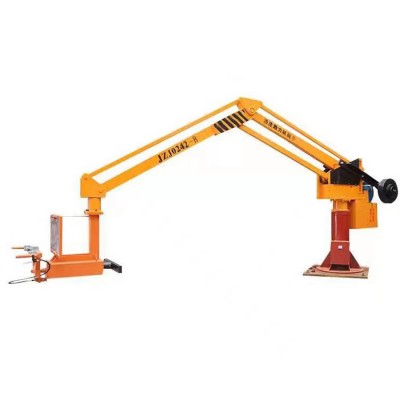
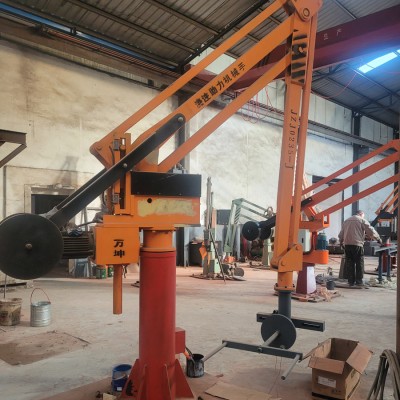
Covers safe installation standards for cantilever jib crane, swing jib crane and motorized jib crane models. It adapts to workshops, warehouses and temporary construction sites, helping operators complete compliant installation and eliminate potential hazards.

Pre-Installation Preparation & Safety Check
Adequate pre-install preparation avoids assembly errors and accidents. All checks below must be finished before starting assembly.
The installation ground must be flat, solid and level with enough bearing capacity to support the equipment and rated load. Soft, hollow, sloped or slippery ground is prohibited to prevent sliding or tipping.
Clear all obstacles within the full lifting and rotation range of the cantilever crane. Reserve sufficient vertical and horizontal space to avoid structural collision during operation.
Mark an independent working zone to block irrelevant personnel and equipment, ensuring a safe assembly environment.
Check all structural parts including columns, jib beams, bases, bolts and wheels for deformation, cracks or missing components. Replace damaged parts before assembly to guarantee structural stability.
Verify the integrity and sensitivity of safety devices such as limit stops, anti-slip hooks, brakes and overload protection. For motorized jib crane units, inspect wiring and insulation to avoid electrical hazards.
Confirm equipment parameters match actual on-site lifting demands.
Assembly requires at least two trained operators wearing standard safety protective gear, familiar with installation and safety rules.
Prepare level meters, torque wrenches and conventional hand tools to ensure accurate calibration and standardized bolt fastening.
Step-by-Step Safe Installation Process
Step 1: Place and Fix the Base
Place the counterweight base on flat solid ground, adjust levelness and fully lock all brake wheels. A fixed, level base is the core safety foundation for all portable jib crane on wheels during operation.
Step 2: Assemble the Jib Beam & Support Structure
Install the vertical support column strictly vertical, fasten all bolts with standard torque, then mount the horizontal jib beam. Test the swing jib crane rotation to ensure flexible, jamming-free movement.
Step 3: Install Lifting Mechanism & Safety Accessories
Install the hoist, safety hook and limit switches in standard positions, and test lifting and sliding flexibility.
For electric models, complete standardized wiring and full insulation protection to prevent leakage and short circuits.
Step 4: Overall Calibration & Structural Inspection
Recheck all bolt fasteners, calibrate column verticality and jib levelness to eliminate assembly deviation.
Test full jib rotation and hook lifting travel to ensure the cantilever jib crane runs smoothly without noise or stuck movement.
Post-Installation Safety Debugging & Acceptance
No-Load Test
Run full-stroke no-load rotation and lifting tests. Qualified results mean smooth operation, sensitive brakes and limit functions, without jitter, noise or stagnation.
Load Test
Perform static load testing with a standard safety margin and suspend the load for observation. No beam deformation, tilt or loose bolts qualifies the cantilever crane for load operation.
Safety Function Acceptance
Verify height limit, overload protection, anti-drop hook and wheel locking functions. All safety mechanisms must work effectively to meet industrial operation standards.
Frequently Asked Questions
Does a portable jib crane need professional workers to install?
-
Trained on-site operators can finish standard mechanical assembly per official guidelines. However, electrical wiring for motorized jib crane must be handled by qualified electricians to avoid electrical risks.
Can I install and use the crane on outdoor uneven ground?
-
No. Uneven, soft or pitted outdoor ground causes unbalanced stress, leading to beam tilt, poor rotation and tipping hazards. Outdoor installation requires flat, compacted and solid ground.
Is load test necessary after every disassembly and reinstallation?
-
Yes. Repeated disassembly affects assembly accuracy and fastening tightness. No-load and static load tests are mandatory to confirm the portable jib crane on wheels meets safety standards before formal use.